As a pet parent, there is nothing quite as heart-wrenching as seeing your dog in a state of distress. Whether they are barking frantically at the window or pacing the second you grab your keys, it feels like there’s an invisible wall between you.
You call their name, you offer their favorite toy, but nothing seems to work.
In the world of canine behavior, this is called being "over-threshold." It’s the moment your dog’s nervous system takes over and their "learning brain" completely shuts down. If your dog won’t listen, they aren't being "bad", they are overwhelmed.
Here is how to bridge that gap and bring your pup back to calm.
1. Decode the Secret Language of "Bad" Behavior
Behavior is communication. To stop your dog's restlessness, we must understand the root cause. Most "naughty" behaviors are actually survival responses:
-
The Protective Response: Lunging on a leash isn't aggression; it’s often a vulnerable dog trying to create space.
-
The Separation Cycle: Destruction while you’re gone isn't spite. It’s a panic response. Often, these pups have "leftover energy" that hasn't been burned off, turning into nervous chewing.
-
The Vigilance Trap: A dog that can’t settle during the day often lacks a true sanctuary. A place where they feel safe enough to let their guard down.
⚡ Quick Fix for Restless SleepERS
If your dog can't seem to find a "safe spot," the environment is likely the culprit. Our Luxurious Pelsbarn Sofa/Calming Bed is engineered with raised edges to mimic a mother’s coat, instantly lowering cortisol levels.
2. Low-Stress Habits to Lower the Baseline
Before training can work, you have to lower your dog's daily stress levels. Try these three "Quick Wins" today:
-
-
Establish Predictable Rituals: Dogs crave routine. Feeding, walking, and "quiet time" at the same hour every day reduces the "panic spikes" in anxious dogs.
- Swap Fetch for a "Sniff-ari": High-intensity chasing spikes adrenaline. Instead, let your dog lead the walk and sniff every bush. Sniffing naturally lowers a dog's heart rate.
-
Create a No-Disturb Zone: Ensure your dog has a dedicated space (like their Pelsbarn bed) where they are never pestered by kids or guests.
-
Want to know more about helping your dog stay calm? Read our more in-depth blog on dog training here
3. The "Behavioral Bridge": When Love Isn't Enough
Even with the best routine, some dogs live with a baseline of anxiety that is simply too high for training to "stick." You cannot teach a drowning person to swim; first, you have to get them to a life raft.
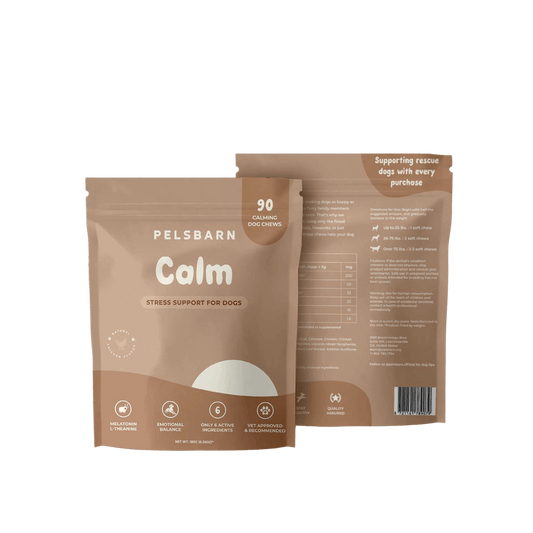
This is where Calming Chews become your strategic "Behavioral Bridge." They aren't sedatives; they are a tool to "lower the static" so your dog can finally hear your voice.
Even with the best routine, some dogs live with a baseline of anxiety that is simply too high for training to "stick." You cannot teach them new habits if they are constantly on high alert.
Our targeted blend uses your dog’s own biology to create focus:
-
L-Theanine & Valerian Root: Reduces the "fight or flight" response. Perfect for dogs that pace or groom excessively.
-
Magnesium: Known as "nature’s relaxant," it helps restless dogs physically settle their muscles.
-
Melatonin: Regulates the "panic clock" for dogs with separation anxiety.

4. How to Use Calming Aids Strategically
A calming aid is most profitable for your peace of mind when used during these "High-Trigger" moments:
-
For Separation: Give a chew 30 minutes before you leave to prevent the "panic spiral" before it starts.
-
For Noise Phobias: Block the terror of storms or fireworks by pre-treating the nervous system.
-
For Social Confidence: Help a shy dog feel "brave" enough to enjoy a walk without hiding.
The Ultimate "Calm Home" Bundle
True canine wellness is a journey of patience and the right tools. By combining a physical sanctuary with nutritional support, you give your dog the mental space they need to grow into the relaxed companion they were meant to be.
Ready to see the difference?
-
[Browse our Calming Beds] – To provide a physical safe haven.
-
[Shop our Calming Chews] – To bridge the gap in training.